Flower
Bevlog

Archive for the ‘alcohol beverages generally’ Category

When Does Wine = Spirits?

Plenty of regulators don’t know or don’t care about the difference between wine and spirits. Paul Jorgensen reviewed a recent and noteworthy trademark dispute showing this. Paul is a widely experienced trademark lawyer and is Of Counsel to this firm. He explains as below.

If you’re reaching for a beer, you’ll probably not accidentally grab that bottle of vodka, will you? Looking to pair that great salmon dish with a nice chardonnay usually won’t mean that you accidentally grab a six pack at the convenience store, right? Yes, even though you know that there’s a big difference between beer, wine and spirits (how they are made, sold and who drinks them, for example), you may be surprised to find out that not everyone does. The U.S. Patent & Trademark Office, for example, does not know the difference and continues to demonstrate this with new legal cases decided through its judicial branch, the Trademark Trial and Appeal Board (TTAB).

Who cares? You will if you are trying to register your beer, wine or spirits trademark. Unless you want to waste your money on an application that the PTO will reject, it is increasingly important to do a thorough trademark search first for any confusingly similar marks. That search should cover not only products the same or similar to your product (e.g., beer), but also all other alcohol products (e.g., wine and spirits too) regardless of how distant you think they are from your product. A recent trademark legal case drives this point home once again.

Remember, the PTO will refuse your trademark if it is likely to cause confusion with a confusingly similar mark that was registered or applied for before you applied for your mark. In the case Miguel Torres, S.A. v. Complejo Industrial RM, S.A. de C.V., Opposition No. 91188401 (May 17, 2011), an applicant for the mark GRAN SOL & Design for tequila was opposed by the owner of the registered mark GRAN VINÃ SOL for wines. The wine mark owner thought it would be damaged if the tequila mark was registered.

After finding that the marks were sufficiently similar to cause confusion if they were used on similar goods, the TTAB looked at the similarity of the goods. The TTAB bought the arguments that wine is similar to tequila because 1) they both travel in the same channels of trade (bars, restaurants, liquor stores, and online); 2) the purchasers are ordinary consumers; 3) one product may be substituted for another in drinks; 4) both are inexpensive and purchased on impulse; and 5) consumers either don’t see or don’t note the distinguishing name and address of the bottler, packer, or importer that appear on the label.

Commenting on the same case, The TTABlog observes:  “Applicant submitted substantial evidence regarding the strict regulations governing alcoholic beverages in the United States. … The Board was not impressed.” The blog concludes that “The Board’s opinion, with numerous case citations, makes it clear why it is futile to argue that one alcoholic beverage is not related to another for Section 2(d) purposes.”

Never mind all the counter arguments that you can make about your discerning consumers, your distinguishable price points, and your different sales methods. Nope, this is only the most recent of TTAB and court cases that show that the law has a blurry view or is blind to important distinctions in the beverage industry. If you are thinking of a snappy new trademark, you stand warned – do your homework first, or better yet, have an experienced trademark attorney help you understand the risks.

Paul Jorgensen keeps a close watch on trademark issues affecting beer, wine and spirits. He is affiliated with this firm as Of Counsel and can help with a wide range of trademark and contract issues.

Related Posts:

Tags:

Posted in:

alcohol beverages generally


Email This Post Email This Post     |    Print This Post Print This Post     |    


Sen. Schumer Says Labels Take Too Long

Sen. Charles Schumer spoke at a Finger Lakes winery late last week and said many wine labels take too long to get approved. He was especially concerned about labels submitted to TTB by New York’s more than 300 wineries. MPNnow.com reported:

the delays — sometimes up to three months — result in wineries not being able to market their wines. The Washington, D.C., agency’s staff has been shaved by budget cutbacks over the last decade while the tide of label-approval applications from wineries nationwide almost doubled from 69,000 in 1999 to 132,500 in 2010, said spokesman Tom Hogue. “And that doesn’t take into account any of the time going back and forth with applicants to make sure labels they’ve submitted actually meet the legal requirements,” Hogue said.

John Martini, co-owner of Anthony Road Wine Co. said:

label approval used to take a week. One label he submitted online May 12 was approved June 15, but he said he has heard horror stories of approvals taking 75 to 90 days. He said new wineries often have long delays because their labels don’t meet the specifics of the label law, which was approved after Prohibition ended. However, he said, “Every winery has a goofy TTB label story.”

The Senator’s press release, and letter to TTB, are here. Key points are:

  1. Many New York wineries have received rejected labels from TTB with a request to correct one issue, only to make that change and receive notification of a new correction. This creates a back and forth or ping-pong effect that can result in weeks of backlogs and headaches for these wineries, and prevents bottles from hitting the shelves. Schumer asks that the TTB clearly identify all of the issues that need to be addressed on the first rejection.
  2. Now New York wineries are reporting it can take at least one month to receive approval of an electronically-filed COLA application and two months for a paper application. It takes even longer in the event TTB rejects a label and it must be corrected and resubmitted to re-start the COLA process.
  3. For new wineries, the effect can be devastating as one winery reported waiting almost a year for label approvals which nearly kept them from opening for business this year.
  4. Wine industry experts estimate that as many as 10% of the labels waiting in the application process are personalized labels produced to commemorate special events like weddings and birthdays. In the past, TTB permitted wineries to simply apply once for approval of a template to ensure it contained the required regulatory and safety warnings, after which the winery could personalize the artwork on the front of the labels to suit the specific event. TTB now requires individual approval as the labels are changed to suit the occasion.

I would like to see more news about the one that took almost a year. While Sen. Schumer makes some good points it is something of a platitude to say TTB needs to handle far more than 100,000 labels per year quicker, with fewer mistakes, and with fewer people. He does not propose much by way of specific solutions. The suggestions about personalization (as at point 4 above) are not a cure-all because TTB does allow some personalization as here, and TTB probably never allowed one template approval to cover more than one brand, type or appellation.

Related Posts:

Tags:

, ,

Posted in:

alcohol beverages generally


Email This Post Email This Post     |    Print This Post Print This Post     |    


TTB Products from Majority Muslim Countries

I can find plenty of alcohol beverages made in Romania, for example, from the above lookup at TTB’s website. But I can’t find anything from Saudi Arabia.

Oh yes, it’s easy to say that Saudi Arabia is a major, majority-Muslim country and so I should not expect to find a single drop of alcohol beverages flowing out from or in to that country. Wikipedia says no less than 100% of the population is Muslim.

On the other hand, Turkey has far more Muslims, at 99% of the population — and no less than 370 label approvals in the TTB database. A recent wine approval is here.

Indonesia has more Muslims than any other country and also has about 25 label approvals in the database. Here is Panther Beer.

Algeria has at least a few approvals. A wine example is here. Morocco has a few hundred approvals, with a recent wine example here. Egypt has a code, but I don’t see any approvals.

Rounding out the top 14 Muslim countries, the following countries (in addition to Saudi Arabia) do not even have a TTB lookup code:  Afghanistan, Bangladesh, Iran, Iraq, Malaysia, Pakistan, Sudan. Some of these countries are so strict that not even soy sauce or vanilla extract is tolerated.

Related Posts:

Tags:

, ,

Posted in:

alcohol beverages generally


Email This Post Email This Post     |    Print This Post Print This Post     |    


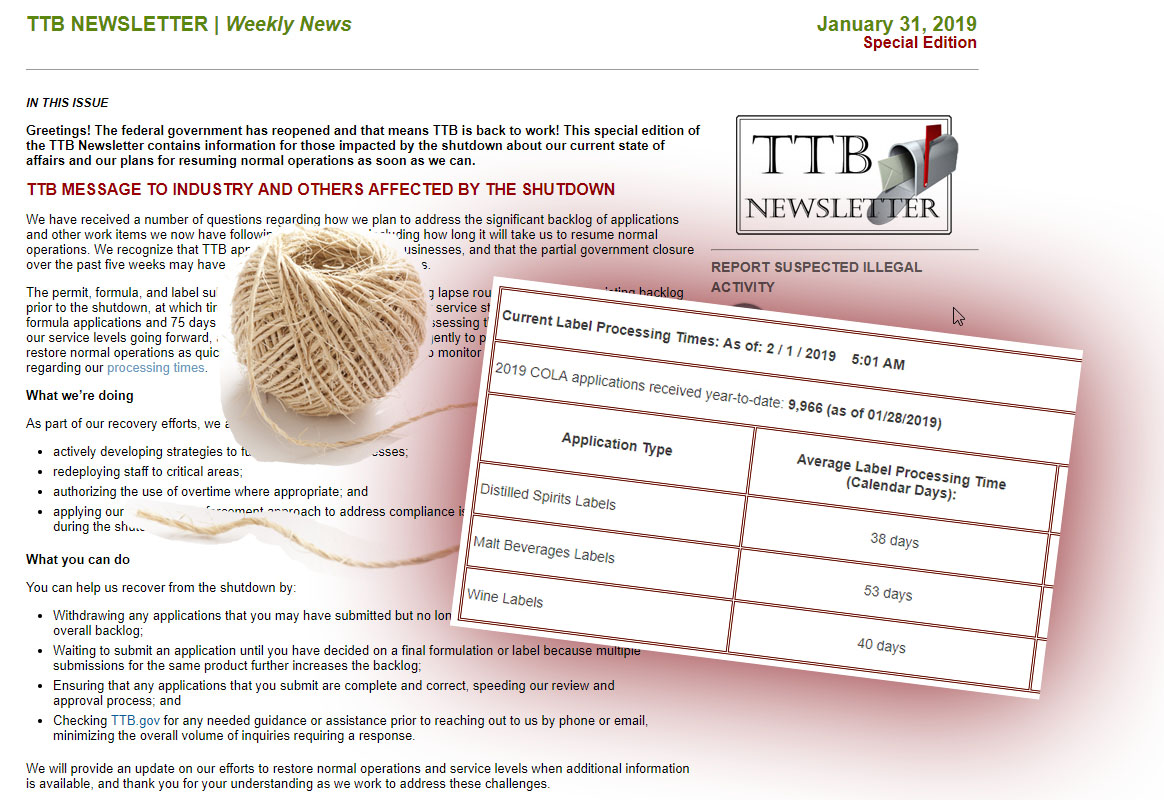
Streamlining COLAs?

It may be safe to put away that gnarly old ruler, from fifth grade. A few days ago, TTB announced that it will ease up on scrutinizing your cpi’s and mm’s. At first this sounds like a good thing, and the “streamlining” as described — because many are the frustrations about waiting on a coveted COLA — only to find it lying in the tatters of rejection, because of a few letters too big or too small.

Industry Circular 2011-04 says:

(TTB) will no longer examine labels to determine whether the images included in the applications meet the type size, characters per inch, and contrasting background requirements.  As a result, TTB will no longer return applications for correction due to these issues.  However, TTB reserves the right to review and return applications for these reasons when it deems necessary.

In some ways this may be good, especially if it speeds up the system and makes TTB more efficient. But the main effect may be a shift of this not so trivial burden over to the applicant. There is no change to the various CFR rules requiring all your cpi’s and mm’s to be just right, and this Circular in no way mitigates that burden. In fact, TTB hastens to add:  “The responsible industry member has always been obligated to ensure proper labeling for their products. In order to remind industry members of their continued responsibility for compliance, TTB will now include a qualification statement on all COLAs consistent with the purpose of this circular.” A real-world and early example is here (see just below the signature). If you think it’s not fun to get a “needs correction” notice after a few weeks, saying a few letters are too small — compare it to the pain of being told the same after you shipped a few hundred thousand cases.

There is no shortage of changes at TTB in recent months. In addition to all the changes noted here and above, TTB also brought back (a somewhat more limited form of) label expedites a few days ago.

Related Posts:

Tags:

, ,

Posted in:

alcohol beverages generally


Email This Post Email This Post     |    Print This Post Print This Post     |    


Design Patents

I got to talking with Dan Matauch the other day. He is a leading package designer in Michigan, at Flowdesign. I would have been impressed enough that he handled the design for Honest Tea. But he also handled Peet’s Tea, and Xango (aka Tiger Blood), and most of the designs really appeal to me. The list goes on and on, with Catdaddy Carolina Moonshine, Blue Ice Vodka, and the not-to-be-ignored Bawls and Stubb’s.

I was fairly surprised to see that Dan worked on the package design for Pama Pomegranate Liqueur — and it had some kind of patent. The March 2010 press release says:

To differentiate its product, PAMA Spirits turned to the expertise of Flowdesign to develop a custom bottle that was both unique and could be patented. … Flowdesign is a unique branding firm where experience is infused in both brand graphics and structural design. Founded in 1997, Flowdesign has led the brand design field in custom structural design with 10 prestigious GPI (Glass Packaging Awards).

It surprised me because the conventional wisdom seems to be that it’s normal to get a trademark related to alcohol beverages — but it’s not realistic to get a patent. The conventional wisdom may be too simple. We have covered several alcohol beverage-related patents in the past, such as Malt Liquor, Cubes, and Fruity Caps. To understand this better, I talked with Paul Hletko. Paul is perfect to dissect this because he happens to be a patent lawyer — and runs Few Spirits (of Evanston, Illinois). Paul explained as follows:

The beverage alcohol business is exceptionally competitive.  Innovative companies are always trying to distinguish themselves to stand out from the competition, while others try to engage in “sincere flattery.”  Brands can go a long way by distinguishing themselves with distinctive and unique propositions, but this can attract copying.  After investing the time and money for uniqueness, it is rare that a brand welcomes a copycat.  Protecting against these problems can be expensive short term, but prove highly valuable long term. One of the first strategies to protect innovation is the use of trademarks.  However, trademarks are “usage” based and thus have certain advantages and disadvantages.  In particular, it can be difficult to gain traction with a new trademark. This short post is not intended to address trademarks – another topic for another day.

Another potential strategy is to seek patent protection for unique and nonfunctional designs.  In the beverage alcohol industry, this typically means unique bottle designs. For example, the PAMA brand secured design patent protection for a new bottle. D598,777 S claims this unique bottle shape, and gives its owner the exclusive right to make, use, or sell bottles with that design for the life of the patent.  Other designs could also qualify for design patents, such as a unique bar top (Blanton’s) or the like. A design patent covers the design of an object, so long as the design is not mandated by the function.  Additionally, the design must be novel as well as not obvious to one of ordinary skill in the art.  Unlike trademarks, however, design patents have a limited life span, and the patentee may be faced with questions about what to do after the patent expires.  But, so long at the design patent remains in force, the owner of the design patent has the exclusive right to make, use, or sell the design.

Unlike trademarks, design patents are based on registration, and prior to registration, the design patent application must be examined to ensure that the design is indeed novel, useful, and nonobvious.  Unfortunately, this can cost money, but the advantage of the exclusive right to make, use, or sell may justify the investment.  If your product is getting a new bottle or other design flourish, you should consider trying to protect the investment. By no means does this brief note apply to all situations, and it is not legal advice, but it should help you talk with your attorney – consult your attorney for guidance on how best to capitalize on your unique situation.

Thus, if one of your brand’s differentiating characteristics is a new bottle design or other similar packaging, consider and evaluate whether a design patent would be appropriate. Paul explained that the cost will likely be significantly lower than the investment in the new design itself (molds, designers, etc.) and the investment may prove highly valuable when the “flattery” starts.

Related Posts:

Tags:

, , , ,

Posted in:

alcohol beverages generally


Email This Post Email This Post     |    Print This Post Print This Post     |    


Feedburner Get bevlog via email. Enter email address:

Delivered by FeedBurner

RSS Subscribe to the RSS feed


This blog has been enhanced by WeFixWP