Posts Tagged ‘business strategy’
Puzzle Time Wines
As lawyers, we would never condone playing games on wine labels. But here are two examples where TTB was okay with it.
On the left, Puzzle Time wine has a word search game.
On the right, the Fetzer label features a “rebus.” That’s right, a rebus. The approval describes a rebus as “a kind of word puzzle that uses pictures to represent words or parts of words.” Can you read the rebus on this label? I don’t want to spoil the fun here, but the answer can be found on the label approval.
Related Posts:
Tags:
Posted in:
Email This Post
|
Print This Post
|
Forty Proof Beer

Once upon a time, the federal government prohibited the disclosure of alcohol content on malt beverage labels. The rationale was to protect public health by discouraging brewers from competing in “strength wars,” to sell more product. It took years of persistence by Coors Brewing Company and a ruling from the Supreme Court in 1995 to persuade TTB (then ATF) to allow the practice.
Did the strength wars ever materialize, once the rules changed? Among the major brewers, not really. In fact, we noted that there is war of a different kind — increasingly lighter beers (in alcohol and caloric content) from Anheuser-Busch and MillerCoors.
But the craft beer movement appears to have its own strength war. “Extreme beers” — beers with intense flavors and alcohol contents at three, four or even five times the amounts in a typical American lager — help small brewers stand out in an increasingly crowded marketplace. And yes, they have many more calories too.
Boston Beer Company offers one of the strongest beers available for sale in the United States, with their Utopias, at 24% alc./vol. and a whopping 732 calories per 12 ounce serving (as per Skilnik).
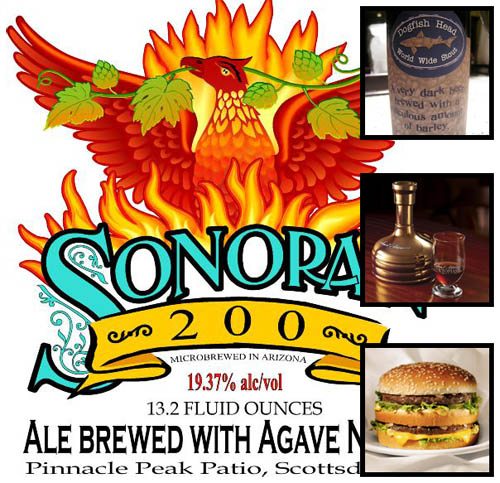
Dogfish Head Craft Brewery’s 2002 release of World Wide Stout is listed at 23.04% alc./vol. and has approximately 666 calories per 12 ounce serving.
Although the offerings from Boston Beer and Dogfish Head top 20% alc./vol., the labels do not disclose the actual alcohol content. Sonoran Brewing Company’s Sonoran 200 is not so coy. It weighs in at 19.37% alc./vol. and has the highest alcohol content we’ve seen listed on a TTB-approved beer label. No caloric content details are readily available, but one might reasonably expect this 13.2 ounce bottle to be roughly equivalent to a Big Mac (at a scant 576 calories).
Related Posts:
Tags:
business strategy, legally interesting/controversial, policy, processing
Posted in:
Email This Post
|
Print This Post
|
Is Beer the New Wine?

At a 2009 National Alcohol Beverage Control Association (NABCA) panel discussion, Boston Beer Company’s Jim Koch boldly proclaimed that “beer is the new wine.”
According to Wine and Spirits Daily, Koch said:
With the emergence of the new mentality about beer driven by small craft brewers, America is starting to create a beer culture in the same way America has created a wine culture.
Is Koch right? The labels tell part of the story. Lately there are many examples of beer labels with terms and elements formerly associated only with wine.
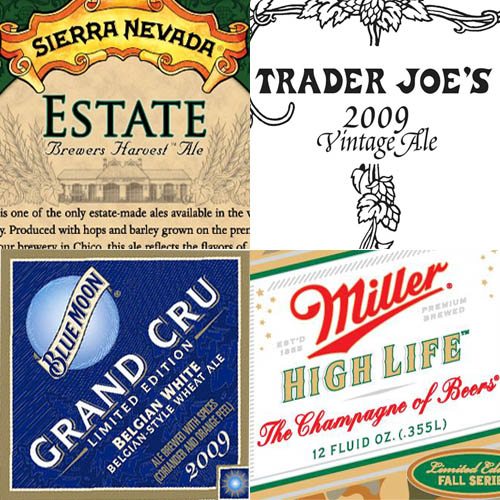
First is Sierra Nevada’s Estate Brewer’s Harvest Ale. TTB sets forth strict rules for wine labeled with the word “estate.” One such rule is that the wine must be produced from grapes grown on land owned or controlled by the bottling winery. According to Greg Kitsock of the Washington Post, Sierra Nevada produces their Estate Ale with hops and barley grown only at their brewery in Chico. The label adds that “this ale reflects the flavors of our surroundings in California’s fertile Central Valley.”
Second is Trader Joe’s 2009 Vintage Ale, produced by Unibroue of Canada. For wine labels, it is clear that a vintage date means one thing: the year in which the grapes were harvested. What exactly does it mean on beer? The Trader Joe’s label tries to explain. “You might be used to seeing vintages on wine; perhaps not so much on beer. And that’s what makes this ale so special.” The label also says that the 2009 Vintage Ale was produced in 2009, in limited quantities, and that it tastes and looks different than those released in previous years.
Third is Blue Moon Grand Cru Limited Edition from MillerCoors. The labeling takes design cues from traditional Champagne labels. It has a vintage date and also mentions “Grand Cru” (meaning “great growth” in French), which is a term generally associated with French wines. Our last and maybe most famous example is Miller High Life, “The Champagne of Beers.”
From a labeling and marketing standpoint, it appears that some beers are trying to develop the same prestige that wine enjoys with the American public. So Koch may well be right. After all, he sells a single bottle of beer for $150, a price near or above that for many of Napa and Bordeaux’s finest.
Related Posts:
Tags:
business strategy, hybrid, policy
Posted in:
Email This Post
|
Print This Post
|
Miller and Bud Race Yet Again
First there was Miller Lite, at about 96 calories per 12 ounces (back around 1975).
In later years the non-alcoholic malt beverages (or “near beers”) became more common, with leading brands such as Clausthaler and Kaliber at about 80 calories (as per Skilnik).
Now, in the past year, it appears we have a race to the bottom. That is, Miller Genuine Draft 64 came out about a year ago. It is, not surprisingly, 64 calories per 12 ounces (and 2.8% alc./vol.).
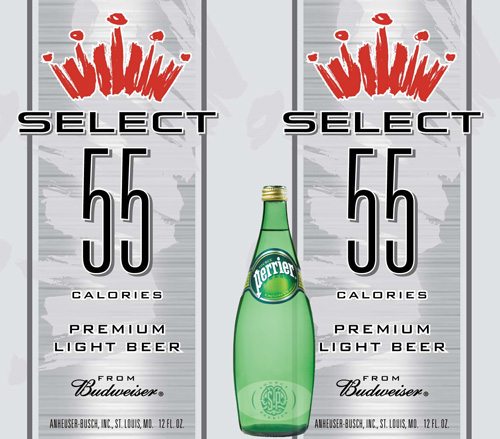
Lower and more recent still is Bud Select 55. It is only 55 calories and 2.4% alc./vol.
This is one important trend over the past 34 years. In a future post we will look at a countervailing trend toward very high calorie/alcohol malt beverages.
All of this leads us to wonder, where will this go in the next 34 years? When the Jonas Brothers hit middle age, will they be drinking Bud Exträ Epic Mega Select 11 (down near the lower limits for the legal definition of beer)? Hops flavored Perrier?
Related Posts:
Tags:
brand extensions, business strategy, serving facts/allergens, would you drink it?
Posted in:
Email This Post
|
Print This Post
|
The Sports Illustrated Index: Advertising

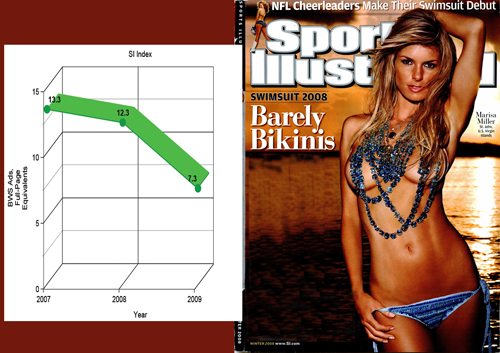
We got to thinking that the much-ballyhooed swimsuit issue, published in Sports Illustrated every winter, might shed some light on trends in the economy, alcohol beverage advertising, and print advertising more generally. In the past, the swimsuit issue has been a prime place for beer and spirits advertising.
This year’s issue is 178 pages, chock full of bikinis. Only 7.3 pages are devoted to alcohol beverage ads. This is nearly a 50% drop off from two years ago, when the economy (and print advertising) were flying a lot higher.
A big part of this is due to one brand. Budweiser advertising was at seven pages in 2007 and down to a skimpy two pages in 2009.
Almost all of the 2009 ads seem to be customized for the swimsuit edition. Back in 2007, it was about half and half. There is essentially no wine advertising in any of these three issues, and beer accounts for 2/3 while spirits are at about 1/3.
Herewith, two of the better alcbev-centric ads tailored to this magazine.

The text on this Glenlivet Scotch ad may be hard to read, and is worth repeating. It says:
THE GLENLIVET was ESTABLISHED when SWIMWEAR was a lady’s SAFEGUARD from the elements. Back in 1824, even the SLIGHTEST display of ANKLE could put the FIRE in any gentleman’s HEART. While such MODESTIES have been cast aside, FORTUNATELY, the QUINTESSENCE of good taste is still to be ENJOYED with the SINGLE MALT that STARTED IT ALL.

They are both from 2007 and the later ones don’t seem as good.
Related Posts:
Tags:
Posted in:
Email This Post
|
Print This Post
|