Flower
Bevlog

Posts Tagged ‘processing’

Forty Proof Beer

bigbeers

Once upon a time, the federal government prohibited the disclosure of alcohol content on malt beverage labels. The rationale was to protect public health by discouraging brewers from competing in “strength wars,” to sell more product. It took years of persistence by Coors Brewing Company and a ruling from the Supreme Court in 1995 to persuade TTB (then ATF) to allow the practice.

Did the strength wars ever materialize, once the rules changed? Among the major brewers, not really. In fact, we noted that there is war of a different kind — increasingly lighter beers (in alcohol and caloric content) from Anheuser-Busch and MillerCoors.

But the craft beer movement appears to have its own strength war.  “Extreme beers” — beers with intense flavors and alcohol contents at three, four or even five times the amounts in a typical American lager — help small brewers stand out in an increasingly crowded marketplace. And yes, they have many more calories too.

Boston Beer Company offers one of the strongest beers available for sale in the United States, with their Utopias, at 24% alc./vol. and a whopping 732 calories per 12 ounce serving (as per Skilnik).

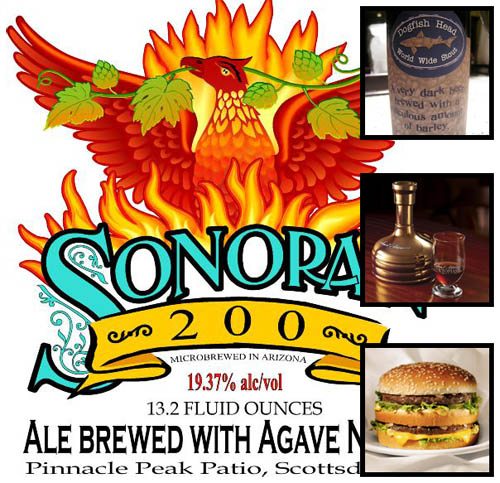
Dogfish Head Craft Brewery’s 2002 release of World Wide Stout is listed at 23.04% alc./vol. and has approximately 666 calories per 12 ounce serving.

Although the offerings from Boston Beer and Dogfish Head top 20% alc./vol., the labels do not disclose the actual alcohol content. Sonoran Brewing Company’s Sonoran 200 is not so coy. It weighs in at 19.37% alc./vol. and has the highest alcohol content we’ve seen listed on a TTB-approved beer label. No caloric content details are readily available, but one might reasonably expect this 13.2 ounce bottle to be roughly equivalent to a Big Mac (at a scant 576 calories).

Related Posts:

Tags:

, , ,

Posted in:

flavored malt beverage, malt beverage


Email This Post Email This Post     |    Print This Post Print This Post     |    


Diamonds, Gold & Vodka: What Recession?

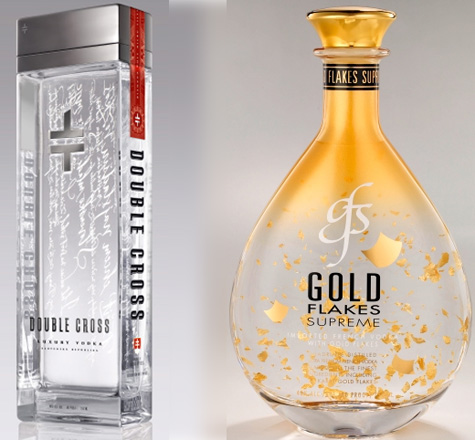
One is filtered through diamonds and the other has gold flakes in the bottle. Double Cross Vodka is made in the Slovak Republic, where it is “filtered with diamond dust.” The small red strip label says so. Thanks to The Intoxicologist and Emily Haile for bringing this to our attention. Luxist explains:

The seven-times-distilled spirit uses only 100 percent organic, estate-grown winter wheat and mountain spring water drawn from aquifers located 200-feet below ground level. Double Cross’ diamond dust filtration system is said to provide unprecedented filtration capability because of the “unique shape and sub-micron size of the diamond dust particles.”

Rather than filter through the costly substance and leave it at the distillery, Gold Flakes Vodka puts the 24 karat gold right in each bottle. Luxist says it will retail for about $60 per bottle.

Related Posts:

Tags:

, ,

Posted in:

cream liqueur, vodka


Email This Post Email This Post     |    Print This Post Print This Post     |    


Sparkling Spirits

Click for O2 COLA

Sparkling wine has been around a long time. Drew Lambert says the English invented it back in the 1600s, before the French. Beer got its fizz around the same time.

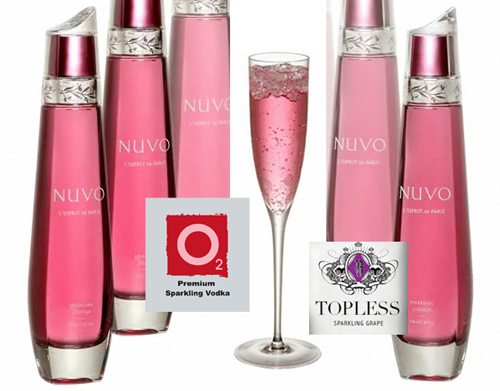
It took another 400 years for spirits to acquire a fizz, and now sparkling spirits are here with a vengeance. Nuvo was early, first approved on December 11, 2006. It is a sparkling liqueur made with vodka, sparkling wine and fruit nectar, in France. Three days earlier, TTB approved O2 Sparkling Vodka. It’s currently made in England and imported by Admiral. Topless is a third example of this trend. It is vodka with natural flavors and CO2 added. Topless is made in Holland and imported by Drinks Americas of Wilton, Connecticut.

Related Posts:

Tags:

,

Posted in:

distilled spirits specialty, liqueur, vodka


Email This Post Email This Post     |    Print This Post Print This Post     |    


Spirits from the Deep Oceans

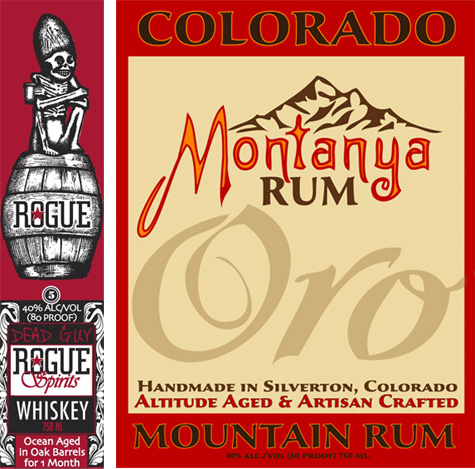
Rogue Spirits makes a Dead Guy Whiskey “Ocean Aged in Oak Barrels for 1 Month.” Is it a gimmick or a good idea? Let’s just say they are not alone in searching high and low to make innovative products. Ocean Vodka “uses deep sea water from Hawaii” according to Luxist. “The water is drawn from 3,000 feet below the surface of the Pacific Ocean … to be devoid of surface pollutants.”

Montanya Distillers is headed in the other direction. They make Mountain Rum in Silverton, Colorado, where it is “altitude aged” far from the seas.

Related Posts:

Tags:

,

Posted in:

rum, vodka, whisky


Email This Post Email This Post     |    Print This Post Print This Post     |    


Whey Neutral Spirits

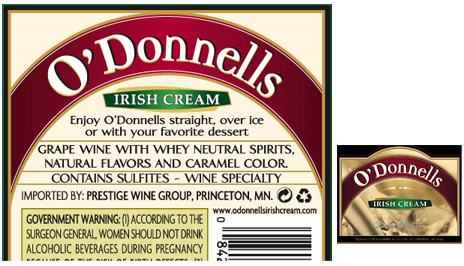
There is a lot going on with this label. First and most obviously, it’s in the style of a cream liqueur, but it’s classified as a wine. The back label is in the style of a front label. And it’s made with whey neutral spirits. Wikipedia says whey is “the liquid remaining after milk has been curdled and strained; it is a by-product of the manufacture of cheese or casein.” It is further evidence that wine and spirits can be made from a huge number of commodities. Dr. John Murtagh was an expert on converting whey into spirits:

Since 1979 John has been retained as a consultant to Carbery Distillers Ltd. of Ireland, on the development and operation of their process for the fermentation of cheese whey, to produce very-high-quality neutral spirit for beverage and industrial uses. He has also been responsible for the commissioning of three whey-alcohol plants for Carbery licensees in New Zealand and the U.S., and continues to visit and assist these plants.

Related Posts:

Tags:

, , , , , ,

Posted in:

cream liqueur, wine specialty


Email This Post Email This Post     |    Print This Post Print This Post     |    


Feedburner Get bevlog via email. Enter email address:

Delivered by FeedBurner

RSS Subscribe to the RSS feed


This blog has been enhanced by WeFixWP