

Posts Tagged ‘rejections’
Charity Labels
Here are a few charity-themed alcohol beverage labels. They are becoming more common, to the point where TTB does have a specific policy. In general, of course the charity language has to be truthful and non-misleading — but also, it needs to have a bit of specific information (such as the name of the charity).
Vets Vodka is bottled by Terressentia of North Charleston, South Carolina and benefits the National League of Families (POW-MIAs).
Hope Wine is bottled by Sonoma Wine Company of Graton, California and benefits “our troops.”
Third, Charity Case wine is made by One True Vine, LLC of St. Helena, California and benefits “charities serving children and families in and around Napa County.”
Related Posts:
Tags:
Posted in:
Email This Post
|
Print This Post
|
Fancy Commodity Statements
Do you see something wrong with the above labels? All of them have “fancy” commodity statements, rather than one that is more stripped down. A plain commodity statement would be something like DISTILLED FROM GRAIN rather than DISTILLED FROM FRENCH WHEAT, as on the Grey Goose label above.
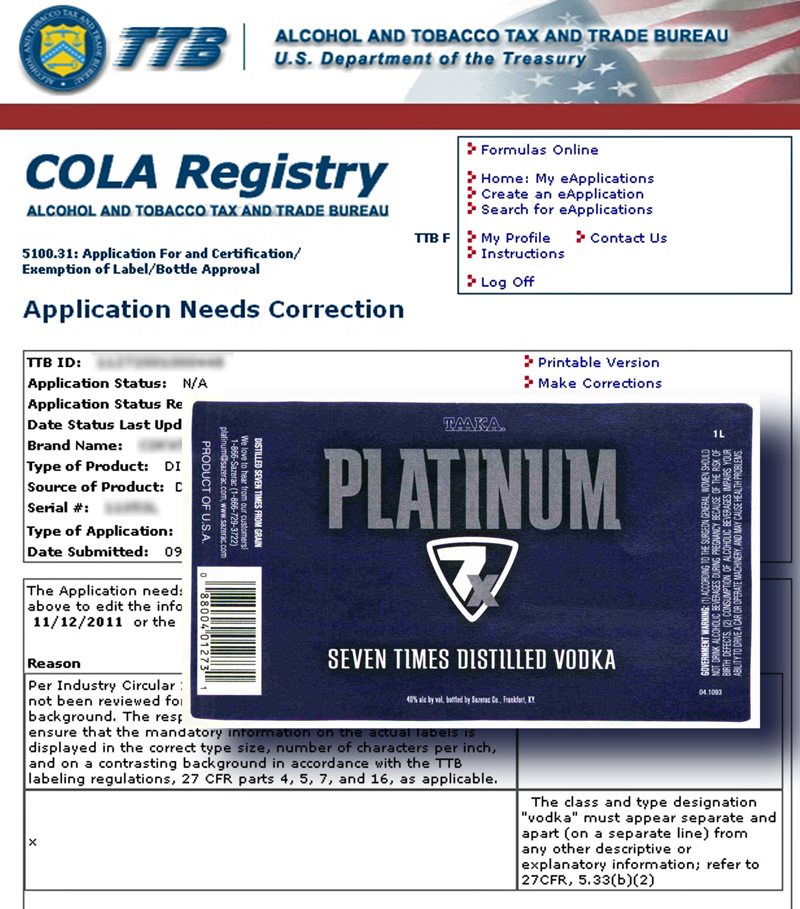
On the one hand, there are many label approvals, such as the above. On the other hand, TTB recently rejected DISTILLED FROM NEW YORK GRAIN and said it must appear as DISTILLED FROM GRAIN instead. Can both the approvals and the rejection possibly be right? Between the two, what do you think is more right? This can be critical because most vodka and gin labels must have a compliant commodity statement, to show the commodity from which the base spirits are distilled.
The examples above are Heart of the Hudson Vodka (NY Apples), Tuthilltown Vodka (75 pounds of Hudson Valley Apples), Grey Goose Vodka (French Wheat), Core Vodka (Hudson Valley Apples), Bootlegger Vodka (American Grain), and China Beach Vodka (California Grapes). Other examples are Cold River Gin (Maine Potatoes), Soft Tail Vodka (Washington State Apples), True North Vodka (Michigan Rye), and Flathead Vodka (Idaho Sugar Beets).
Related Posts:
Tags:
Posted in:
Email This Post
|
Print This Post
|
Bag-in-Box Wine
It only takes a few minutes to upload your label to COLAs Online, if it only has about one panel, such as this beer label. On the other hand, if you have a bag-in-box container, it’s a lot more work. TTB wants every panel of the box uploaded separately. Gallo’s Peter Vella wine is a good example of how TTB wants it. Each of six panels is uploaded so that the entire label approval runs six feet or more when printed.
It is common for bag-in-box containers to show the equivalent measure in bottles, ounces or glasses. This can trip up the unwary, as in this recent rejection. TTB generally requires not just the size of the box but also the size of each unit to which the box is compared (for example, “5L is equivalent to 6.5 750 ml. bottles”). The Vella label shows how TTB wants it.
Related Posts:
Tags:
Posted in:
Email This Post
|
Print This Post
|
Adult Beverages

Here it is, in all its glory, at long last. TTB’s “areola” policy.
From time to time, depending on the circumstances, TTB will say these particular body parts are “obscene” or “indecent” and must be covered. Here is a recent example of such a rejection. It says “Please cover the areolas on the woman.” And these, by way of another example, are certainly well covered.
The label above is Amethystos dry white wine, from the Drama region of Greece.
Related Posts:
Tags:
legally interesting/controversial, policy, rejections, risqué, sexual
Posted in:
Email This Post
|
Print This Post
|
Remove the Word “Digestif”

Fernet-Branca has been well known around the world as a “digestiv” since about 1845. The above poster shows Fernet-Branca described as a “digestivo.” By contrast, the US label, on the right, bears no reference to this key term.
TTB does not allow any reference to digestif, digestiv or similar. Here is an example of a recent rejection, wherein TTB explains that the term is not allowed, and why. TTB regards it as a therapeutic claim.
Eric Asimov explains:
Digestives were historically intended as palliatives, meant to counter all sorts of ailments and physical imbalances. They may no longer be assigned quite the same medicinal value today as they were a few hundred years ago, but count me among the many who believe they can help to settle that queasy feeling.
Fernet-Branca is one of the more famous examples of a digestif, but there are others, such as Fernet Stock, Escorial, Becherovka, Averna, bitters, amaro, etc. In general, digestifs are intended to be consumed after a meal, with dessert of coffee. By contrast, aperitifs, such as Aperol and Campari, are most often served before meals.
Related Posts:
Tags:
legally interesting/controversial, policy, rejections
Posted in:
Email This Post
|
Print This Post
|