Posts Tagged ‘statement of composition’
Bacardi with Aloe

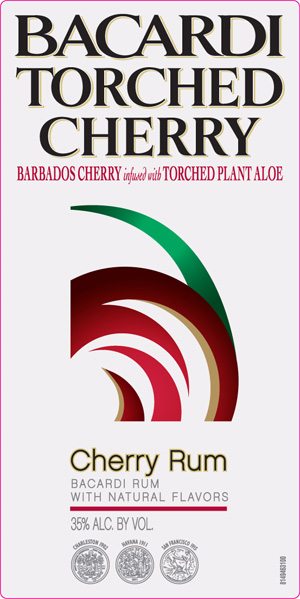
Here is Bacardi Torched Cherry Rum with Natural Flavors. It is apparently made with “torched plant aloe.”
The use of aloe as a flavor is curious because it’s not clear how aloe tastes, and various sources say aloe does not taste especially good. This product is one of very few TTB products that seem to contain aloe. Even these find no room for aloe. As of this writing, the other flavors in the line are:
- Dragon Berry
- Limon
- Peach
- Raspberry
- Orange
- Coconut
- Apple
- Melon
Apart from aloe, this label suggests TTB will allow the term “Rum” to appear larger than “with natural flavors.” And yet, on other distilled spirits specialties, such as an identical product made with a vodka base, it is unlikely TTB would allow “Vodka” to appear in a more prominent way compared to the rest of the statement of composition. It is not clear why TTB polices the term “vodka” so rigorously, but not other comparable terms, such as “rum.” Another example of this is, the government clearly allows “cherry rum” (as above) but would probably not allow “cherry vodka.” This example is easier to understand because, as a matter of law and history, rum is only made from cane products, so confusion is unlikely. But in the case of a “cherry vodka” it would be more difficult to be sure about whether the product is distilled from cherries or just has a cherry flavor. It is possible that “vodka” is more sensitive due to controversy around this Skyy Blue label from many years ago.
Related Posts:
Tags:
brand extensions, ingredients, policy, statement of composition
Posted in:
Email This Post
|
Print This Post
|
Gin & Juice & Music

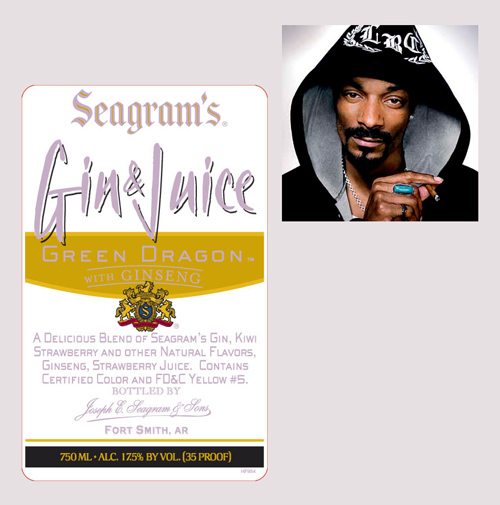
Calvin knows a thing or two about the booze business. Not to mention all manner of other intoxicants. (I need to warm up to calling him by his assumed name.)
Sixteen years ago Cordazar Calvin Broadus (aka Snoop Dogg) released a little song called “Gin & Juice.” It set off a big chain of events. It helped to launch his career, garnering a 1995 Grammy nomination. It also unleashed a slew of covers, such as this country version by The Gourds (it is slightly less obscene than the original, if only because it’s a little harder to make out the words).
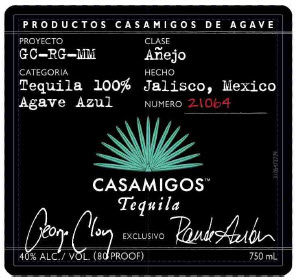
And most to the point, it also apparently unleashed the Gin & Juice product line as above. It’s possible that Seagram got there first, but I would tend to doubt it, based on not much more than the age of the song. The song specifically refers to the Seagram and Tanqueray brands of gin. There is a whole lot in the song to horrify right-thinking persons, such as flagrant disregard for women, drug laws, mom’s wishes. But even more pernicious is the nonchalance about drinking and driving. In the original video, Snoop doesn’t quite cruise down the boulevard while sipping his gin and juice, but he might as well, as he sits behind the wheel and re-fills his cup.
Most of the lyrics are too obscene, even for this adult publication, but the most pertinent and repeatable are as follows:
Now, that, I got me some Seagram’s gin
Everybody got they cups, but they ain’t chipped in
Later on that day
My homey Dr. Dre came through with a gang of Tanqueray
Related Posts:
Tags:
music-booze-society, statement of composition
Posted in:
Email This Post
|
Print This Post
|
Igniting a Controversy
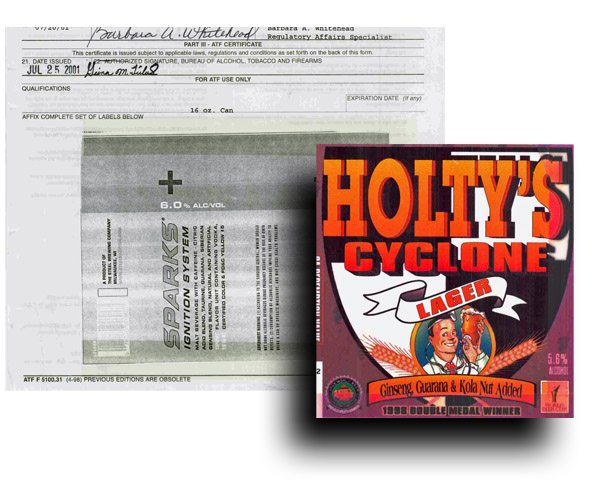
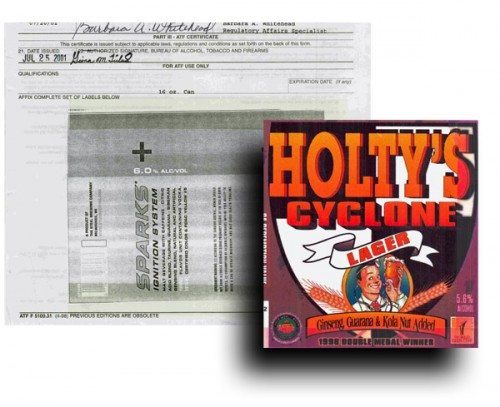
This Sparks label may well be the label that ignited a big controversy, coming to a boil eight years later. As near as we can tell, it is the first or one of the very first label approvals showing the direct addition of caffeine. Since then, TTB has approved hundreds or thousands of labels with a similar caffeine-alcohol combination as per this list, as explained by TTB here. Beginning about two years ago, CSPI began vigorously challenging caffeine-alcohol combination, and then the states and the FTC jumped in. In November of 2009 FDA said the drinks probably should not be allowed. Caffeinated Sparks is gone, but the controversy burns on.
Holty’s Cyclone is a much earlier approval, and contains at least two sources of caffeine — but it does not have the directly-added caffeine that makes the 2001 Sparks approval noteworthy. Holty’s is beer with added ginseng, guarana and kola nut. It is quite amazing that Holty’s has an image of a doctor examining the beer and seeming to approve, along with a reference to Dr. Holty. It is also surprising that the product lacks anything resembling a modern statement of composition. The terms are all over the place, from lager to herbs to the stimulants.
Related Posts:
Tags:
caffeine/secondary effects, legally interesting/controversial, policy, statement of composition
Posted in:
Email This Post
|
Print This Post
|
Too Much Rum in the Jumbie
August 28, 2009 was a bad day for Rum Jumbie. In a slew of “approvals,” TTB directed Varela Imports to make “rum” much, much, less conspicuous. TTB said:
When new labels are printed, the word “rum” in your trademark name Rum Jumbie cannot appear more prominent than the Class and type. The [statement of composition] and the words Rum Jumbie must appear in the same color print. … No more use-ups will be granted.
That is, Varela must make their brand name and trademark much less conspicuous because this is not “rum” and the actual designation is “Rum with Natural Flavors.” TTB’s point, essentially, is that Varela is putting far too much rum in the Jumbie. This label emphasizes the rum aspect at least four times.
Jumbie has a trademark, and seems to have argued it here, to not much avail. There is little if any chance that the Trademark Office will come to the rescue and persuade TTB that there is not too much rum in the Jumbie. Also, the above image makes it pretty obvious that the product contains flavor.
It is not clear whether Varela has smashed into an aberration, or an evolving policy. On one hand “rum” is quite prominent and it’s not “rum.” On the other hand, back in 2004, a similar label was good enough under similar rules for the prior importer. Beyond that, spiced rum is in the same category (rum specialties) and it is common on such labels to emphasize the rum.
Related Posts:
Tags:
policy, qualifications, statement of composition
Posted in:
Email This Post
|
Print This Post
|
The Prominence of Vodka
TTB often says the term “vodka” may not appear, in a prominent manner, unless: the product is simple vodka, or qualifying language surrounds the term, in the same font. An example is VODKA WITH NATURAL FLAVOR, where TTB would not usually allow VODKA to be more prominent than WITH NATURAL FLAVOR.
The product above is not plain vodka, and yet the term “vodka” appears in a surprisingly emphasized manner. It is emphasized by being large (about five times the size of the actual statement of composition). It is emphasized by repetition (no less than six appearances). It is also emphasized to the extent that “Smirnoff” is or was synonymous with “vodka.” The true statement of composition is hard to read on this scan and says: “MADE WITH VODKA, GUARANA EXTRACT, NATURAL FLAVORS, CARAMEL COLOR, CAFFEINE & SODA WATER.” The other color is off to the side.
TTB has underscored this vodka rule by asserting, on other approvals for this brand: “When new labels are printed, the word ‘vodka’ cannot appear more prominent nor stand alone. [Vodka & Guarana] must appear together and in the same size type print/font.” TTB felt strongly enough to allow it with all of the following restrictions: Arizona sales only, test marketing only, 23,000 cases only, and six months only. Curiously, TTB also said “When new labels are printed, all references to ’soda’ must be removed.” TTB appears to be concerned that an errant minor could mistake the above (or other alcohol beverages bearing the term “soda”) for a soft drink.
Related Posts:
Tags:
ingredients, policy, statement of composition
Posted in:
Email This Post
|
Print This Post
|