Flower
Bevlog

Posts Tagged ‘statement of composition’

Too Much Rum in the Jumbie

jumbie

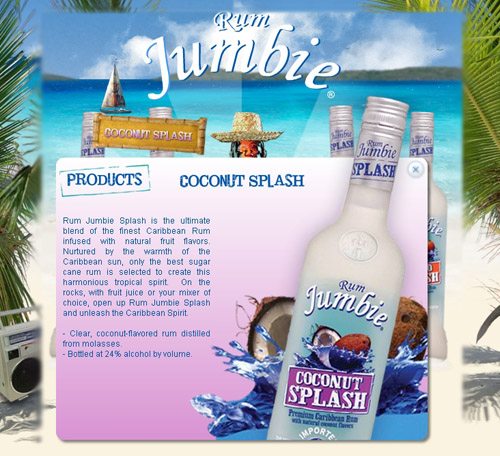
August 28, 2009 was a bad day for Rum Jumbie. In a slew of “approvals,” TTB directed Varela Imports to make “rum” much, much, less conspicuous. TTB said:

When new labels are printed, the word “rum” in your trademark name Rum Jumbie cannot appear more prominent than the Class and type. The [statement of composition] and the words Rum Jumbie must appear in the same color print. … No more use-ups will be granted.

That is, Varela must make their brand name and trademark much less conspicuous because this is not “rum” and the actual designation is “Rum with Natural Flavors.” TTB’s point, essentially, is that Varela is putting far too much rum in the Jumbie. This label emphasizes the rum aspect at least four times.

Jumbie has a trademark, and seems to have argued it here, to not much avail. There is little if any chance that the Trademark Office will come to the rescue and persuade TTB that there is not too much rum in the Jumbie. Also, the above image makes it pretty obvious that the product contains flavor.

It is not clear whether Varela has smashed into an aberration, or an evolving policy. On one hand “rum” is quite prominent and it’s not “rum.” On the other hand, back in 2004, a similar label was good enough under similar rules for the prior importer. Beyond that, spiced rum is in the same category (rum specialties) and it is common on such labels to emphasize the rum.
Related Posts:

Tags:

, ,

Posted in:

distilled spirits specialty


Email This Post Email This Post     |    Print This Post Print This Post     |    


The Prominence of Vodka

Click for COLA

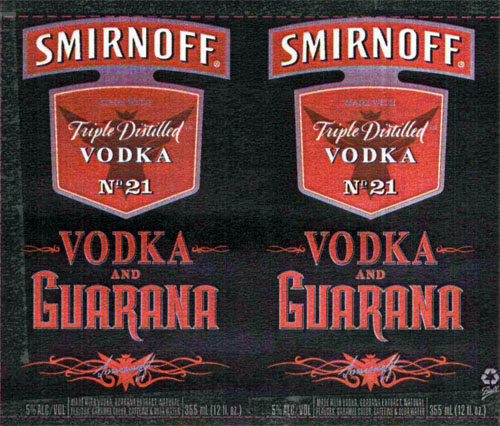
TTB often says the term “vodka” may not appear, in a prominent manner, unless:   the product is simple vodka, or qualifying language surrounds the term, in the same font. An example is VODKA WITH NATURAL FLAVOR, where TTB would not usually allow VODKA to be more prominent than WITH NATURAL FLAVOR.

The product above is not plain vodka, and yet the term “vodka” appears in a surprisingly emphasized manner. It is emphasized by being large (about five times the size of the actual statement of composition). It is emphasized by repetition (no less than six appearances). It is also emphasized to the extent that “Smirnoff” is or was synonymous with “vodka.” The true statement of composition is hard to read on this scan and says:  “MADE WITH VODKA, GUARANA EXTRACT, NATURAL FLAVORS, CARAMEL COLOR, CAFFEINE & SODA WATER.” The other color is off to the side.

TTB has underscored this vodka rule by asserting, on other approvals for this brand:  “When new labels are printed, the word ‘vodka’ cannot appear more prominent nor stand alone. [Vodka & Guarana] must appear together and in the same size type print/font.” TTB felt strongly enough to allow it with all of the following restrictions:  Arizona sales only, test marketing only, 23,000 cases only, and six months only. Curiously, TTB also said “When new labels are printed, all references to ‘soda’ must be removed.” TTB appears to be concerned that an errant minor could mistake the above (or other alcohol beverages bearing the term “soda”) for a soft drink.

Related Posts:

Tags:

, ,

Posted in:

distilled spirits specialty


Email This Post Email This Post     |    Print This Post Print This Post     |    


Pernod Absinthe

Click for Pernod Absinthe COLA

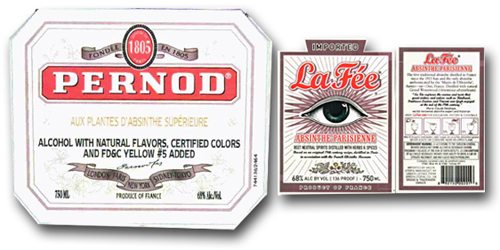
Here (above) is the COLA for Pernod Absinthe, at long last. It was extremely difficult to find, in TTB records, and a lot of absinthe enthusiasts have been looking for the COLA for upwards of a year. For example, Alan Moss’ Real Absinthe Blog does a great job tracking all the US-approved absinthes, but he too was not finding the approval. As of today his blog says “Pernod Aux Extraits de l’Absinthe: announced … for July 2008 launch. … Where is the label approval?”

We think it’s fairly interesting that the Pernod label, for some reason, lists CERTIFIED COLORS AND FD&C YELLOW #5 in big text on the front label. But the comparable La Fee absinthe shows “caramel color & certified colors FD&C Blue #1 & FD&C Yellow #5″ in much smaller text, on the back label.

Related Posts:

Tags:

, ,

Posted in:

absinthe


Email This Post Email This Post     |    Print This Post Print This Post     |    


Whey Neutral Spirits

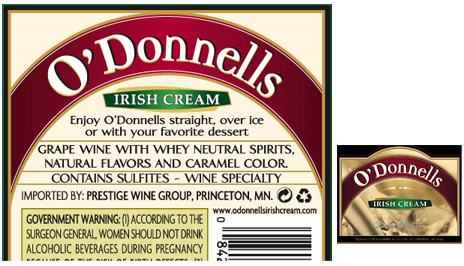
There is a lot going on with this label. First and most obviously, it’s in the style of a cream liqueur, but it’s classified as a wine. The back label is in the style of a front label. And it’s made with whey neutral spirits. Wikipedia says whey is “the liquid remaining after milk has been curdled and strained; it is a by-product of the manufacture of cheese or casein.” It is further evidence that wine and spirits can be made from a huge number of commodities. Dr. John Murtagh was an expert on converting whey into spirits:

Since 1979 John has been retained as a consultant to Carbery Distillers Ltd. of Ireland, on the development and operation of their process for the fermentation of cheese whey, to produce very-high-quality neutral spirit for beverage and industrial uses. He has also been responsible for the commissioning of three whey-alcohol plants for Carbery licensees in New Zealand and the U.S., and continues to visit and assist these plants.

Related Posts:

Tags:

, , , , , ,

Posted in:

cream liqueur, wine specialty


Email This Post Email This Post     |    Print This Post Print This Post     |    


The Mighty Mushroom

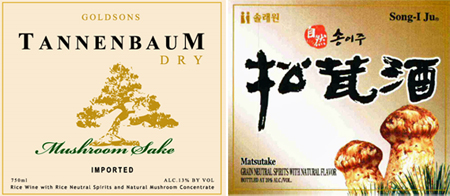
Just when we got accustomed to mushrooms in the entree, two companies in Korea went and added mushrooms to the beverage. Tannenbaum “Mushroom Sake” is Rice Wine with Rice Neutral Spirits and Mushroom. Song-I Ju is Grain Neutral Spirits with Natural Matsutake Mushroom Flavor.

Related Posts:

Tags:

, ,

Posted in:

distilled spirits specialty, sake, wine specialty


Email This Post Email This Post     |    Print This Post Print This Post     |    


Feedburner Get bevlog via email. Enter email address:

Delivered by FeedBurner

RSS Subscribe to the RSS feed


This blog has been enhanced by WeFixWP