Archive for the ‘distilled spirits specialty’ Category
Proof: Booze Makes the World More Colorful
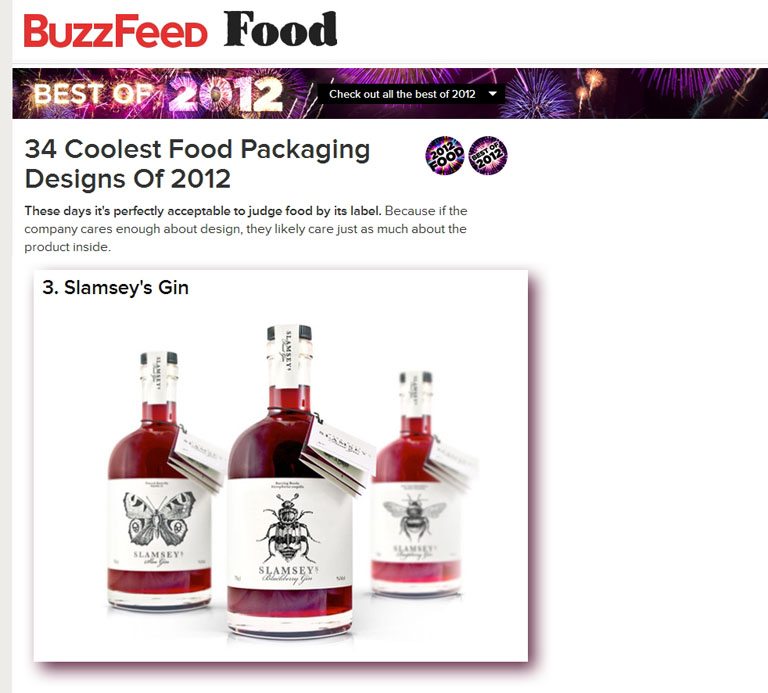
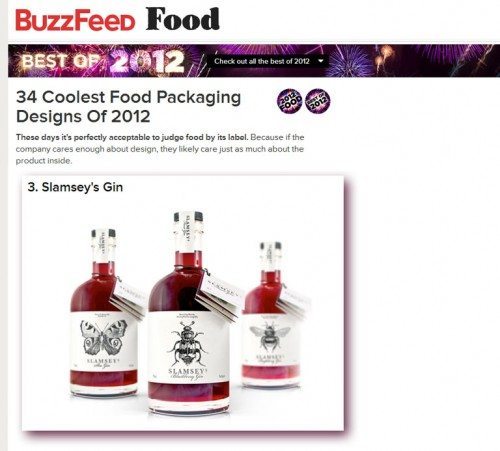
For quite some time, I have noticed that alcohol beverage packaging tends to be prettier than lots of other packaging. Now, perhaps, I am on the verge of proving this hunch, though the manner of proof, in the form of a BuzzFeed article, may be a bit light on evidence.
The article shows the “34 Coolest Food Packaging Designs Of 2012.” Of this sampling, fully 20 are beverages. Of those, no less than 13 (more than a third) are alcohol beverages. Not bad, considering all the other categories represented, such as chocolate, cheese, jam, pasta, and bread.
Within the alcohol beverage category, I think the Slamsey’s Gin (as above) and Dancing Pines Bourbon bottles look good. I did not notice US approvals for those two, or most of the others on the list, so far. So this may be a harbinger that there is plenty of interesting work to look forward to in 2013. Of the products listed, Kraken Spiced Rum is the most familiar, and the US approval is here.
Tags:
Posted in:
Email This Post
|
Print This Post
|
Distilled Beer
Q: What do you call spirits distilled from beer?
A: Not “Spirits Distilled from Beer.”
Every now and then we see a “Bierschnapps” or a “spirit distilled from beer.” But even though beer is the main ingredient, most of the U.S. approvals seem to avoid any reference to “beer” or “bier.” It seems that TTB is not in favor of spirits labels that refer to beer.
In the above example, Woodstone Microspirit seems to be, pretty much, just spirits distilled from beer. Even though the producer probably wanted to describe it as “bierschnapps” on the label, the main description is “Spirits Distilled from Grain and Hops.” The producer, back in 2008, set forth his frustrations here:
Beer Schnapps as a label has not been approved by the TTB for 4 months 3 tries and counting, the formula from the local microbrewery was accepted on the 2nd time through. Its been over 2 years so far and it is fighting me every step of the way. … We are now re-submitting the product with a fanciful name and not calling the product beer schnapps at all.
TTB seems to have allowed a reference to ale but not beer.
Classick is another example of a bierschnapps. I have not been able to find the label approval, but the San Francisco Chronicle discussed the product in 2002:
Bierschnaps, the liquor in question, is relatively unknown outside of its place of origin, Bavaria, Germany. It is made from beer that has been distilled into a clear, 80 proof spirit similar to premium vodka. … Even the Bureau of Alcohol, Tobacco and Firearms hadn’t heard of the spirit, so the government officials insisted that Classick and Mirenda provide samples of German bierschnaps to prove its legitimacy. … Four hundred regulations later, in November 1999, Essential Spirits sent to the shelves its first bottle of Classick Original American Bierschnaps, which is distilled from the company’s own micro-brewed California pale ale. In April 2000 came a partnership with a major craft brewer, introducing Sierra Nevada Pale Ale bierschnaps.
TTB has liberalized in many areas and yet various and sundry pockets of great strictness remain.
Tags:
Posted in:
Email This Post
|
Print This Post
|
The Triple Sec Lobby
The highly secretive and powerful Triple Sec lobby has struck again — this time to require at least one drop of triple sec in certain alcohol beverages. Google it as much as you wish, and you will find little about this uber-secret institution, rumored to have strong ties leading all the way back to France. That’s because it’s secret. Some even say that Sen. John Kerry, with his thinly disguised sympathies for many things French, is Triple Sec’s man in Washington.
On a more serious note, for many years, TTB has required at least some triple sec in products that purport to be margaritas. The policy is here, at page 13 (scroll down to Margarita). The policy is in TTB’s “Beverage Alcohol Manual” for spirits. The BAM can be a handy resource to explain and supplement the regulations. Sometimes, as here, it goes considerably beyond what the law or regulations say. In this particular case, it seeks to mandate that every margarita must have: “Tequila, triple sec and lime or lemon juice or oil or natural lime or lemon flavor.” Here is a recent example of TTB seeking to enforce the rule.
Does such a rule make any sense in this day and age of scarce resources? What is the worst that would happen if such a rule went away? Some may say the rule does not go far enough — and should similarly apply to malt beverages, wines, cocktails prepared at retail premises and even homes. If you have any doubt about the hushed-up threat presented by this rule (explaining how to make various cocktails), do not forget that the same rule also requires just a little bit of cream — or crème as some call it — in a Grasshopper or Pink Squirrel.
Tags:
Posted in:
Email This Post
|
Print This Post
|
Toxic Libations
Has anyone tried these and lived to tell about it? Some people prefer the organic or biodynamic, Others, apparently, lean toward the toxic or deadly. It is nice to see TTB giving consumers some credit for being able to put things in context, and for recognizing that nobody will force them to buy either one of these products (unlike, say, health insurance or government).
Toxic Sludge is an ale made by Blue Point Brewing Company of Patchogue, New York. Jersey’s Toxic Waste, by contrast, is a distilled spirits specialty made by Strong Spirits, Inc., along with Line Brands of Long Branch, New Jersey. Michael Kanbar, of Strong, explains that Strong Spirits “is a contract bottling facility located in Bardstown, Kentucky, ‘The Distilling Capital of the World,’ and does both small and large runs and can handle specialty packaging projects.”
Tags:
drinkwire, parody, would you approve it?, would you drink it?
Posted in:
Email This Post
|
Print This Post
|
Sparkling Vodka
We covered several sparkling spirits products about three years ago, here, and so it may be about time for a redux. There is quite a bit of action on this front, in recent months, perhaps due to the high profile of Nuvo Sparkling Liqueur.
Here is a Sparkling Vodka under the brand name Le Grand Saint. Technically, it is a distilled spirits specialty more than a “vodka” or a specific class/type. The statement of composition (“vodka infused with carbonation”) appears in gold letters near the top of the front label.
Another good example is Prévu. It is unique in the sense that it is sparkling, and liqueur, and organic. It is made with vodka and Cognac, and imported by Simont Enterprises of Los Angeles, California. Prévu also happens to have a great looking website and bottle. If the product is even half as good as what is shown there, I should step away from the computer and go get several bottles.
Tags:
drinkwire, policy, processing, sparkling
Posted in:
Email This Post
|
Print This Post
|