Posts Tagged ‘patent’
Oxygen Enriched Bourbon
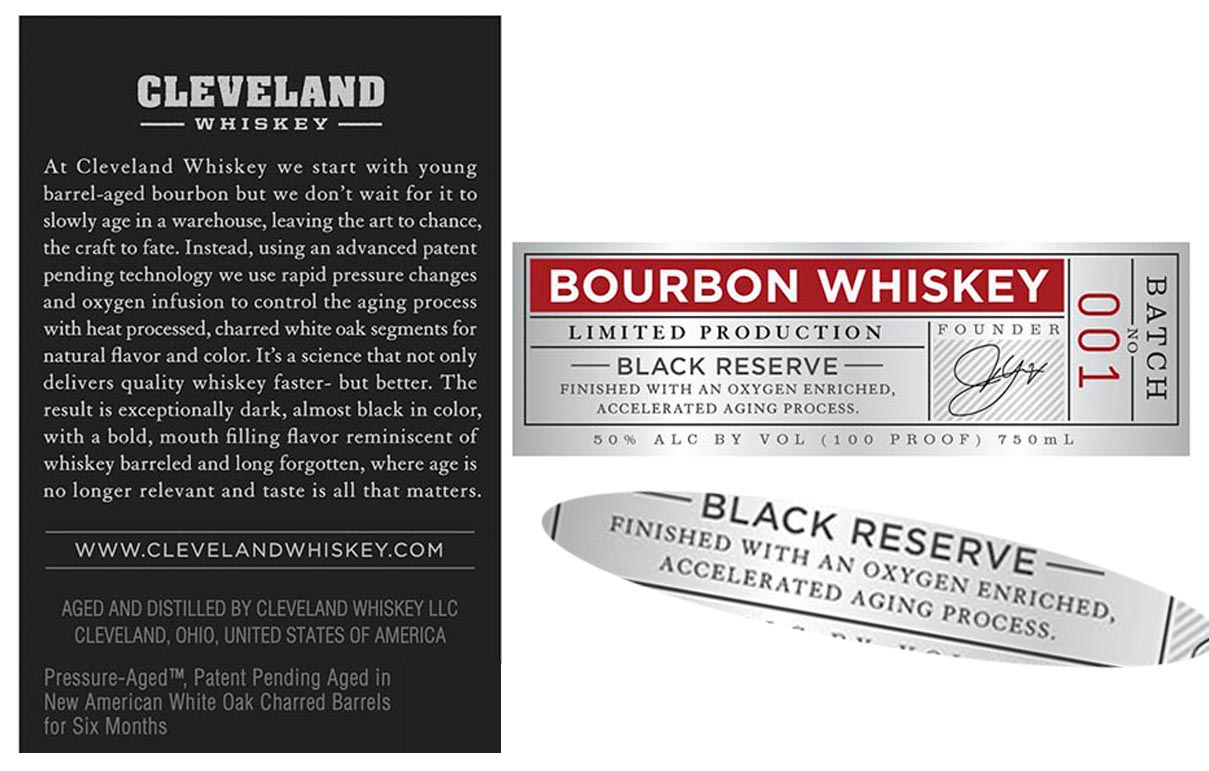
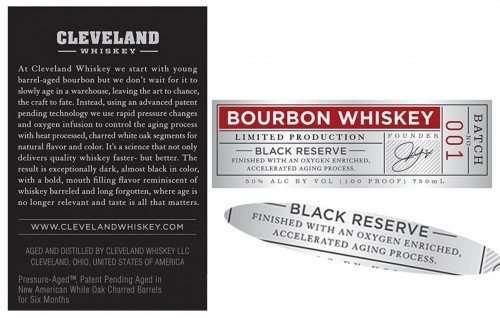
This Bourbon label caught our eye because it makes several big claims. It says:
- FINISHED WITH AN OXYGEN ENRICHED, ACCELERATED AGING PROCESS
- Patent Pending
- Pressure-Aged
- “we use rapid pressure changes and oxygen infusion to control the aging process”
- “age is no longer relevant and taste is all that matters.”
That’s a lot of envelope-pushing and innovation for one label. We happen to know a person who is both an experienced patent lawyer and an experienced whiskey distiller. So, in a future post, we hope to have him review the patent claims and assess whether this is closer to an innovation or a gimmick. The Bourbon is produced and bottled by Cleveland Whiskey, LLC of Cleveland, Ohio. The approval is here. Terressentia’s closely-related patent, also for aging spirits quickly, is described here.
Tags:
legally interesting/controversial, patent, policy, processing
Posted in:
Email This Post
|
Print This Post
|
Design Patents
I got to talking with Dan Matauch the other day. He is a leading package designer in Michigan, at Flowdesign. I would have been impressed enough that he handled the design for Honest Tea. But he also handled Peet’s Tea, and Xango (aka Tiger Blood), and most of the designs really appeal to me. The list goes on and on, with Catdaddy Carolina Moonshine, Blue Ice Vodka, and the not-to-be-ignored Bawls and Stubb’s.
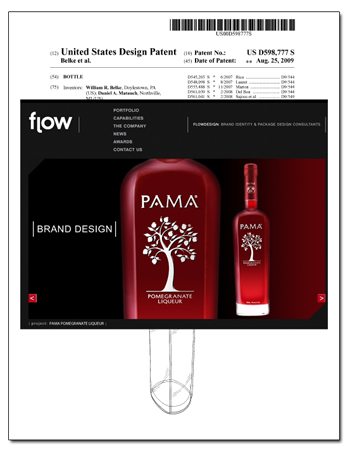
I was fairly surprised to see that Dan worked on the package design for Pama Pomegranate Liqueur — and it had some kind of patent. The March 2010 press release says:
To differentiate its product, PAMA Spirits turned to the expertise of Flowdesign to develop a custom bottle that was both unique and could be patented. … Flowdesign is a unique branding firm where experience is infused in both brand graphics and structural design. Founded in 1997, Flowdesign has led the brand design field in custom structural design with 10 prestigious GPI (Glass Packaging Awards).
It surprised me because the conventional wisdom seems to be that it’s normal to get a trademark related to alcohol beverages — but it’s not realistic to get a patent. The conventional wisdom may be too simple. We have covered several alcohol beverage-related patents in the past, such as Malt Liquor, Cubes, and Fruity Caps. To understand this better, I talked with Paul Hletko. Paul is perfect to dissect this because he happens to be a patent lawyer — and runs Few Spirits (of Evanston, Illinois). Paul explained as follows:
The beverage alcohol business is exceptionally competitive. Innovative companies are always trying to distinguish themselves to stand out from the competition, while others try to engage in “sincere flattery.” Brands can go a long way by distinguishing themselves with distinctive and unique propositions, but this can attract copying. After investing the time and money for uniqueness, it is rare that a brand welcomes a copycat. Protecting against these problems can be expensive short term, but prove highly valuable long term. One of the first strategies to protect innovation is the use of trademarks. However, trademarks are “usage” based and thus have certain advantages and disadvantages. In particular, it can be difficult to gain traction with a new trademark. This short post is not intended to address trademarks – another topic for another day.
Another potential strategy is to seek patent protection for unique and nonfunctional designs. In the beverage alcohol industry, this typically means unique bottle designs. For example, the PAMA brand secured design patent protection for a new bottle. D598,777 S claims this unique bottle shape, and gives its owner the exclusive right to make, use, or sell bottles with that design for the life of the patent. Other designs could also qualify for design patents, such as a unique bar top (Blanton’s) or the like. A design patent covers the design of an object, so long as the design is not mandated by the function. Additionally, the design must be novel as well as not obvious to one of ordinary skill in the art. Unlike trademarks, however, design patents have a limited life span, and the patentee may be faced with questions about what to do after the patent expires. But, so long at the design patent remains in force, the owner of the design patent has the exclusive right to make, use, or sell the design.
Unlike trademarks, design patents are based on registration, and prior to registration, the design patent application must be examined to ensure that the design is indeed novel, useful, and nonobvious. Unfortunately, this can cost money, but the advantage of the exclusive right to make, use, or sell may justify the investment. If your product is getting a new bottle or other design flourish, you should consider trying to protect the investment. By no means does this brief note apply to all situations, and it is not legal advice, but it should help you talk with your attorney – consult your attorney for guidance on how best to capitalize on your unique situation.
Thus, if one of your brand’s differentiating characteristics is a new bottle design or other similar packaging, consider and evaluate whether a design patent would be appropriate. Paul explained that the cost will likely be significantly lower than the investment in the new design itself (molds, designers, etc.) and the investment may prove highly valuable when the “flattery” starts.
Tags:
business strategy, design, patent, policy, trademark
Posted in:
Email This Post
|
Print This Post
|
Cubes of Cachaca
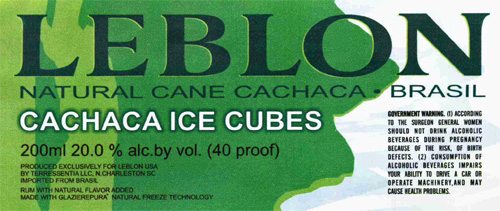
Here is Leblon Cachaca Ice Cubes. It is Brazilian rum (with flavor), in a 200 ml. pack designed to freeze.
This should be of interest to Camper English at Alcademics, as he is inclined to tinker with all manner of alcohol beverages and ice.
The label says this product is “Made with Glazierepura Natural Freeze Technology.” BevNetwork explains that Glazierepura is a newly patented technology that can “freeze any alcohol and does not affect the flavor profile of the spirit.” Even though this Leblon product is only 40 proof, the technology would allow, for example, making ice cubes out of vodka — or even Single Malt Scotch. The US-Israeli company behind this technology partnered with Leblon for the offical US launch, on April 27, 2009 in New York.
Tags:
Posted in:
Email This Post
|
Print This Post
|
Functional Packages, Part 4
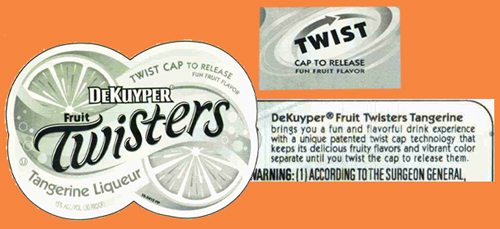
It’s pretty tough to get a patent on a beverage or a beverage package. But here DeKuyper claims a patent on the package. The back label says: “DeKuyper Fruit Twisters Tangerine brings you a fun and flavorful drink experience with a unique patented twist cap technology that keeps its delicious fruit flavors and vibrant color separate until you twist the cap to release them.” This patent application was published two months prior to the label approval and looks related.
This seems like a great, great idea. Unfortunately, it does not seem to have gone anywhere. I can’t find a trace of it, two years after its 2007 approval. In addition to Tangerine, Jim Beam Brands Co. also has approval for Twisters Pear Liqueur and Pink Lemonade Liqueur.
Tags:
Posted in:
Email This Post
|
Print This Post
|