Flower
Bevlog

Posts Tagged ‘speech’

Shelton F’s with Beer, Art, and Commercial Speech

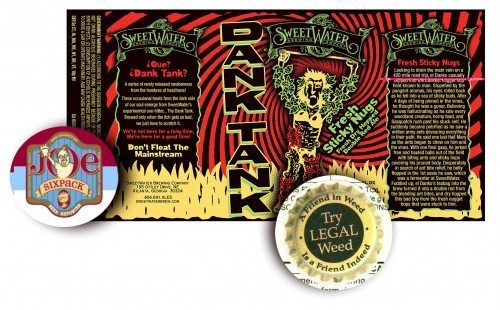
Way back in mid-December of 2012 I would have considered this Shelton Brothers COLA to be, perhaps, an aberration. But upon checking it again, today, I see a few more COLAs with the same word — arguably in need of the fig leafs above.

It is hard to believe that the government did not see the word at issue. On the above-linked COLA it appears no less than three times. This may signal that, as social mores liberalize and budgets shrink, the government has bigger (or fewer) fish to fry. Clearly, it signals that Daniel Shelton does not mind pushing the envelope, or many. The Amherst College magazine unabashedly explains that, after graduating from Amherst, Shelton:

went to a prestigious law school … then clerked for a judge (on a tropical Pacific isle, of all places) and finally secured a position at a venerable firm in Washington, D.C. (but convinced Shea & Gardner that he needed to spend a year bumming around Africa before starting.) … “My Amherst education has not been wasted at all. I use it more in this business than I ever did in lawyering. I never was completely comfortable with the idea of being a lawyer, anyway.”

This creaky old regulation still prohibits any beer labeling that is “obscene or indecent.” At this rate, however, it is difficult or uncomfortable to imagine something that goes too far — or too far for Dan. Many thanks to Mark for showing me these labels.

Tags:

, ,

Posted in:

malt beverage


Email This Post Email This Post     |    Print This Post Print This Post     |    


Is Wine Vegan?

Not that I read the PETA stuff every day, but I could not resist when I stumbled on PETA’s article entitled, “Is Wine Vegan?” It makes the point that:

The majority of people are unaware that wine, although made from grapes, may have been made using animal-derived products. During the winemaking process, the liquid is filtered through substances called “fining agents.” This process is used to remove protein, yeast, cloudiness, “off” flavors and colorings, and other organic particles. Popular animal-derived fining agents used in the production of wine include blood and bone marrow, casein (milk protein), chitin (fiber from crustacean shells), egg albumen (derived from egg whites), fish oil, gelatin (protein from boiling animal parts), and isinglass (gelatin from fish bladder membranes). Thankfully, there are several common fining agents that are animal-friendly and used to make vegan wine. Carbon, bentonite clay, limestone, kaolin clay, plant casein, silica gel, and vegetable plaques are all suitable alternatives.

For those who would prefer not to torment an animal in the course of pouring a glass of wine, The Vegan Wine Guide already lists more than 400 wines. The Vegan Vine seems like a good example. As I flipped through a few of the 400, I was not surprised to see that few if any make direct claims that the wine qualifies as “vegan.” After all, TTB is not known for being footloose and fancy-free about various claims. Foursight Wines has said:

[we were] pleased that the TTB allowed us to state that our wines are suitable for vegetarian and vegan diets. Clos La Chance has begun marketing all vegan wines, but the TTB didn’t allow them to say that the wines didn’t use animal products (see the Wines & Vines article here). Frey is a noted vegan producer but their wines don’t list it on the label. So, unless anyone out there has a correction for me, I have yet to find another U.S. producer with a vegan and vegetarian statement on their wine labels.

If your tastes run in the other direction, you may prefer these libations replete with animal byproducts.

Tags:

, ,

Posted in:

wine


Email This Post Email This Post     |    Print This Post Print This Post     |    


Nobama Beer

What is it about beer that encourages people to say things — they would never want to say on cheese or ketchup labels? In the latest skirmish, an Oklahoma brewer came out with Nobama Beer during the past few weeks.

It appears that TTB was not too fond of this brand name, at least at first. But then Huebert Brewing Company, their lawyer, and the local NBC affiliate went on the offensive, to push the label through, as shown in this video. I must admit, I did not expect to see a TV news story about the finer points of TTB Form 5100.31, Exemptions from Label Approval, or TTB’s renowned beer label reviewer (the one person that has reviewed and approved the label for just about every beer currently available in the US). The first video shows that TTB at first allowed the beer only within Oklahoma, but the above approval, and this later video, shows that TTB shortly thereafter felt compelled to allow it more widely.

The examples of envelope-pushing beer labels are probably too numerous to mention here. And they are certainly not limited to the Obama bashers, as in this example.

Tags:

, ,

Posted in:

malt beverage


Email This Post Email This Post     |    Print This Post Print This Post     |    


Poor, Unprintable Stu

Last week The New York Times had a good article entitled “With Rude Names, Wine Stops Minding Its Manners.” The article focused on the wide variety of Bitch-themed wines in the US marketplace. The article describes Royal Bitch as:

one of a teeming sisterhood of cabernets and chardonnays from a variety of producers with labels like Sassy Bitch, Jealous Bitch, Tasty Bitch and Sweet Bitch. They’re reinforcements for a growing army of rude, budget-priced wines that have shoved their way into wine stores and supermarkets in the past few years — most recently Happy Bitch, a Hudson Valley rosé that made its debut last month.

The article closes by saying:

Winemakers have some way to go before equaling the shock value of Jersey’s Toxic Waste, a specialty spirit. But the bitch category may yield dividends. Take Rae-Jean Beach, a blended white wine. (The name needs to be said aloud.) She’s got a husband, a zinfandel. Sorry, but the name is not printable here.

Though Mrs. Pedasso’s husband may be too “rude” for publication within the august confines of The New York Times Dining Section, it is my pleasure to bring back Mr. Stu Pedasso and his lovely wife, Rae-Jean Beach.

Tags:

, ,

Posted in:

wine


Email This Post Email This Post     |    Print This Post Print This Post     |    


Raging Beer Controversy in Michigan

On or about September 17, 2009, Flying Dog Brewery requested permission to sell Raging Bitch beer in Michigan. About two months later, the Michigan Liquor Control Commission denied the application, asserting: “The Commission finds that the proposed label which includes the brand name ‘Raging Bitch’ contains such language deemed detrimental to the health, safety or welfare of the general public.”

Flying Dog filed a lawsuit last month, in the U.S. District Court for the Western District of Michigan. In a later post, we’ll review the state’s rationale. But for today, we highlight a few of the juiciest portions from the pleadings submitted by Flying Dog (and attorney Alan Gura). The complaint asserts:

Regrettably, the Michigan Liquor Control Commission and its members have taken it upon themselves to control not merely alcoholic beverages, but speech as well. Acting as a censorial board, Defendants wield state authority to impose their personal tastes as a prior restraint against core First Amendment expression that happens to be placed on beer labels.

The supporting memorandum goes on to cite the Staub case wherein the U.S. Supreme Court said:

It is settled by a long line of recent decisions of this Court that an ordinance which … makes the peaceful enjoyment of freedoms which the Constitution guarantees contingent upon the uncontrolled will of an official — as by requiring a permit or license which may be granted or withheld in the discretion of such official — is an unconstitutional censorship or prior restraint upon the enjoyment of those freedoms.

The memorandum argues that the ban is too broad; “preventing all adults from all access to Raging Bitch [in order to protect some children] is hardly a narrowly tailored restriction.” The Butler case calls back from 54 years ago to remind us “by quarantining the general reading public against books not too rugged for grown men and women in order to shield juvenile innocence. … Surely, this is to burn the house to roast the pig.” The brewer’s memorandum concludes:

The First Amendment is incompatible with the notion that government regulators may sit in judgment of a beer label, scrutinizing it for conformance to their personal views on what sort of expression might disturb delicate sensibilities.

If your tender sensibilities are not yet disturbed, you can find other such labels here.

Tags:

, , , , ,

Posted in:

malt beverage


Email This Post Email This Post     |    Print This Post Print This Post     |    


Search Bevlog


Subscribe to the RSS feed

Get bevlog via email.
Delivered by FeedBurner