Posts Tagged ‘type’
Dandelion Wine
Today we have dandelion wine. This piqued our interest because we have heard faint murmurings about dandelion wine for many decades but never really tasted it or knew much about it, so we thought it was time to get a handle on the situation. As it turns out, the murmurings seem to have more to do with Ray Bradbury’s 1957 novel of the same name, and less to do with the popularity of this wine.
We find very little information about the history of this wine. Bigger Than Your Head describes it as well as anyone else we could find:
The closest I have come to a glass of dandelion wine was reading Ray Bradbury’s evocative novel about Midwestern small-town life, Dandelion Wine, about 50 years ago. … One expects a flower wine to be sweet, and this was, but it wasn’t as sweet as I had anticipated. In fact, I found it delicate, finely structured and just balanced by clean acidity. Aromas of spiced pear and fig wafted from the glass, with hints of dusty meadows. In the mouth, those spiced pear and fig qualities persisted, with touches of something wild and foxy, a little weedy, all of this encompassed by a texture that was almost oily. The finish brought in cinnamon and hay. It felt as if I were sipping the essence of a sunny summer’s afternoon on a blustery Fall day.
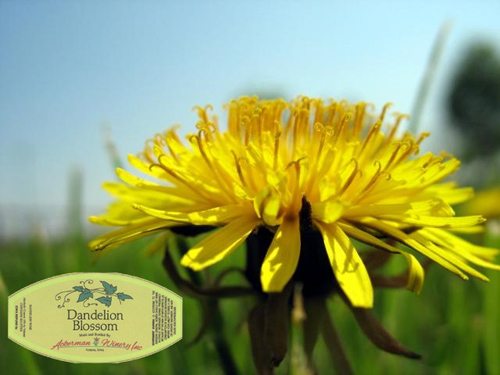
TTB has approved quite a few dandelion wines, and even some dandelion beers. The beer is made by Northern Ales of Northport, Washington. The dandelion wine is classified as an agricultural wine and made by Ackerman Winery of Amana, Iowa.
Related Posts:
Tags:
Posted in:
Email This Post
|
Print This Post
|
Real or Fake?
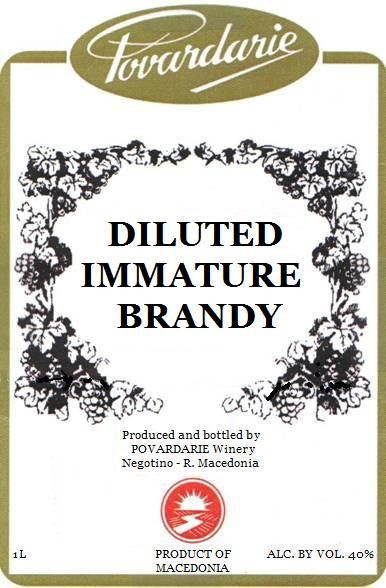
Would anyone expect this to be a big seller in the US? In Macedonia? It’s not clear why it ought to be considered “diluted,” since it meets the 80 proof threshold required for regular brandy. For the answer, click the label.
Related Posts:
Tags:
Posted in:
Email This Post
|
Print This Post
|
Barleywine; Is it Beer, Wine or Both?
Beeradvocate shows over 400 barleywines, from the US alone. Because this type is common, but not nearly so well known as stout or rum, for example, we wanted to take a closer look. Beeradvocate says:
Despite its name, a Barleywine (or Barley Wine) is very much a beer, albeit a very strong and often intense beer! In fact, it’s one of the strongest of the beer styles. Lively and fruity, sometimes sweet, sometimes bittersweet, but always alcoholic. … English varieties are quite different from the American efforts, what sets them apart is usually the American versions are insanely hopped to make for a more bitter and hop flavored brew, typically using American high alpha oil hops. English versions tend to be more rounded and balanced between malt and hops, with a slightly lower alcohol content, though this is not always the case. … Most Barleywines can be cellared for years and typically age like wine. … Average alcohol by volume (abv) range: 8.0-15.0%.
Wikipedia provides additional details : “In the United States, barley wines are required … to be called ‘barley wine-style ales.’ Though this could be taken by some to imply that they are not truly barley wines, in fact it only means that they, like all barley wines, are not truly wines.” Bass was first, around 1900, and the term stems from the fact that many barleywines have an alcohol content similar to that for wine.
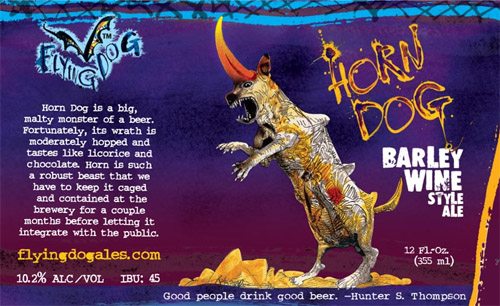
The above label nicely demonstrates the US “requirement” to add “Style Ale.” Based on this TTB definition for “wine,” we don’t see why it’s so obviously beer rather than wine: “When used without qualification, the term includes every kind (class and type) of product produced on bonded wine premises from grapes, other fruit (including berries), or other suitable agricultural products and containing not more than 24 percent of alcohol by volume. The term includes all imitation, other than standard, or artificial wine and compounds sold as wine.” We do acknowledge, however, that this definition (for “malt beverage“) probably fits better.
Related Posts:
Tags:
Posted in:
Email This Post
|
Print This Post
|
Pernod Absinthe
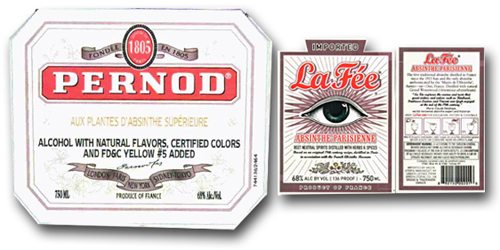
Here (above) is the COLA for Pernod Absinthe, at long last. It was extremely difficult to find, in TTB records, and a lot of absinthe enthusiasts have been looking for the COLA for upwards of a year. For example, Alan Moss’ Real Absinthe Blog does a great job tracking all the US-approved absinthes, but he too was not finding the approval. As of today his blog says “Pernod Aux Extraits de l’Absinthe: announced … for July 2008 launch. … Where is the label approval?”
We think it’s fairly interesting that the Pernod label, for some reason, lists CERTIFIED COLORS AND FD&C YELLOW #5 in big text on the front label. But the comparable La Fee absinthe shows “caramel color & certified colors FD&C Blue #1 & FD&C Yellow #5″ in much smaller text, on the back label.
Related Posts:
Tags:
policy, statement of composition, type
Posted in:
Email This Post
|
Print This Post
|
Zubrowka
An anonymous reader wrote to us about this Zubrowka label as follows:
Free Range Vodka?
As if there weren’t already enough confusion with health food terms like organic, natural, cage-free, and free-range, we’ve found a product that extends the health craze to alcoholic beverages. Meet Zubrowka, bottled with “neutralized” buffalo grass.
What exactly is neutralized buffalo grass? Well, your guess is as good as ours. But if one were to assume that by neutralizing it, it is rendered somewhat inactive or less potent, that begs the question, why bother adding the ingredient in the first place?
So, the purpose of adding a neutralized ingredient is definitely curious, but the label’s image may give us some clues. The image of a large, muscular, and almost fearsome bison dominates the label. One could assume the message here is that by ingesting the very essence of what these imposing creatures thrive on, the drinker would too be infused with virility and strength.
In fact, there is a good reason it’s neutralized. Real bisongrass raises serious health concerns as suggested by Bill Dowd here. Zubrowka is native to Poland and goes back at least 500 years.
Related Posts:
Tags:
ingredients, legally interesting/controversial, type
Posted in:
Email This Post
|
Print This Post
|